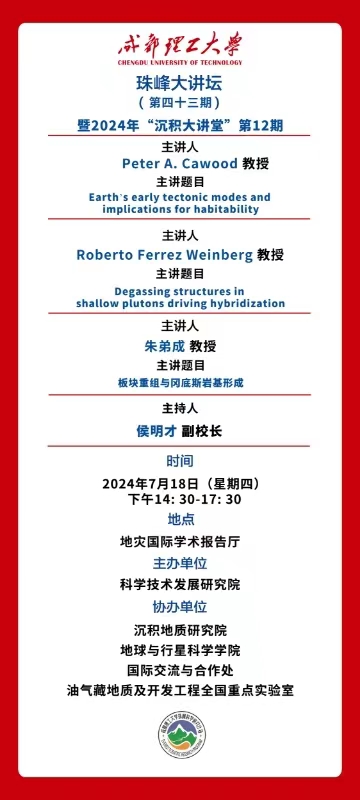
Peter A. Cawood教授
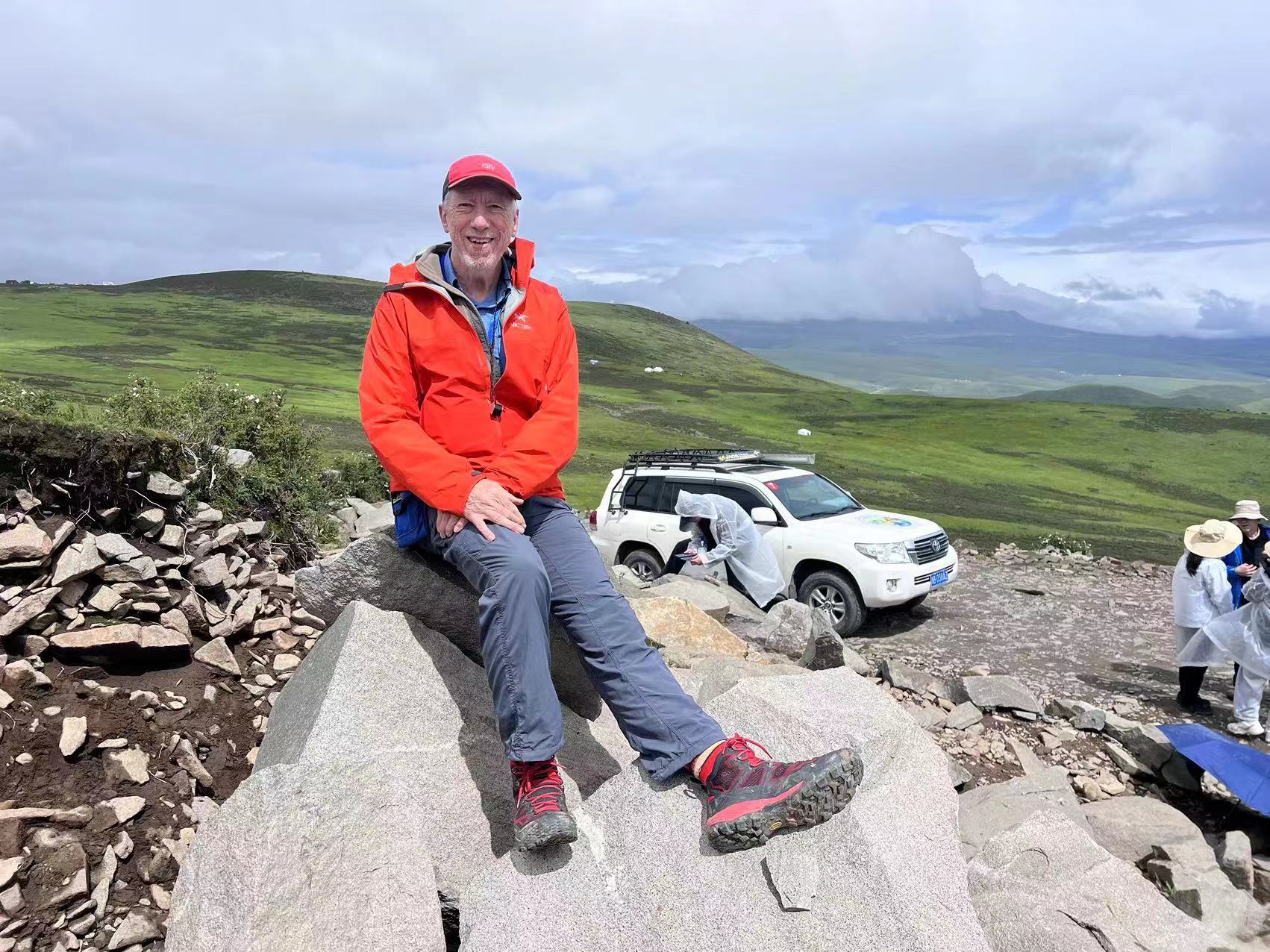 个人简介:Peter Cawood's research has focused on the origin of the Earth's continental lithosphere (crust and upper mantle) and the processes of its generation, stabilization and reworking. He integrates direct field observations with leading laboratory techniques and has worked in regions from Archean cratons to modern and active margins, and at scales ranging from global to microscopic. His work aims to resolve the range of tectonic processes involved in lithosphere formation and the feedback with the rest of the Earth system. His major research contributions include: demonstrating that the archive of Earth history is not simply a record of the processes of crustal generation but markedly biased by the supercontinent cycle; innovative studies on the early stages of collisional orogenesis that link ophiolite generation to its emplacement; a model for the deformation and stabilization of accretionary orogens, and temporal relations to collisional orogenesis; the role and timing for initiation of plate tectonics on the early Earth; and the application of microanalytical techniques to unravel the provenance history and paleogeography of sedimentary basins and orogenic belts. Peter obtained undergraduate and PhD degrees from the University of Sydney and has held academic positions in Australia, New Zealand, Canada, and the UK. He is currently ARC Laureate Fellow at Monash University and is an elected Fellow of the Australian Academy of Sciences, the Royal Society of Edinburgh, and the Geochemical Society and European Association of Geochemistry.
报告简介:Tectonic mode manifests how a planet’s interior is cooling, and it encompasses all the geological activities (e.g., magmatism, deformation, metamorphism, sedimentation) that characterize the planetary body. Tectonic processes exert first-order control on factors key to planetary habitability. For example, tectonic mode controls the long-term prevalence of surface oceans, the sustenance of physicochemical conditions (e.g., temperature) favourable for metabolic activity, fluxing of elements in and out of the planet’s interior and thereby, the availability of bio-essential nutrients (e.g., C, O, H, N, P, S). However, all tectonic modes do not regulate these processes efficiently. For example, stagnant-lid mode restricts heat and material exchange between a planet’s interior and surficial reservoirs compared to plate tectonics. Further, certain factors determining a planet’s tectonic mode – like internal heat budget, mechanical behaviour of rocks, and volatile content – can vary with time, leading to the prevalence of different tectonic modes during planetary evolution. Thus, a planet’s habitability is critically intertwined with its tectonic evolution.
Modern Earth is the only known planet with plate tectonics, felsic crust, and life. Plate tectonics has resulted in a Goldilocks environment for long-term habitability via chemical cycling across the Earth system, regulating temperature through the carbonate-silicate cycle, sustaining oceans at the surface, and developing bimodal hypsometry with emergent felsic crust releasing bio-essential minerals through weathering and erosion. This has resulted in diverse habitats facilitating life’s complex phylogenetic tree. However, life initiated on Earth in the Hadean or early Archean when non-plate-tectonic modes like the stagnant- or squishy-lid modes are inferred to be prevalent. Their potential to promote habitability is unknown, with few studies suggesting that they may lead to habitable conditions. Nevertheless, our terrestrial planetary neighbours’ records suggest that such modes are unlikely to provide the environmental stability necessary to develop a long-term phylogenetic landscape. The geochemical cycling of elements through these modes may occur (e.g., via magmatism and episodic recycling of lithosphere) but is likely to be spatially and temporally discontinuous and limited, thereby limiting the supply of bio-essential nutrients and longevity of oceans on a planetary surface. As such, these modes inhibit a surficial environment in long-term dynamic equilibrium, leading to inhospitable habitats either through the development of a run-away greenhouse (e.g., Venus) or the loss of early atmosphere and oceans to space (e.g., Mars).
Thus, the tectonic evolution of Earth and its resultant habitability are a predictable consequence of its position, composition, size, and heat energy within the solar system. These conditions may serve as a template to search for exoplanet habitability; however, a degree of unpredictability will remain in knowing whether a similar set of planetary criteria would produce the same outcome.
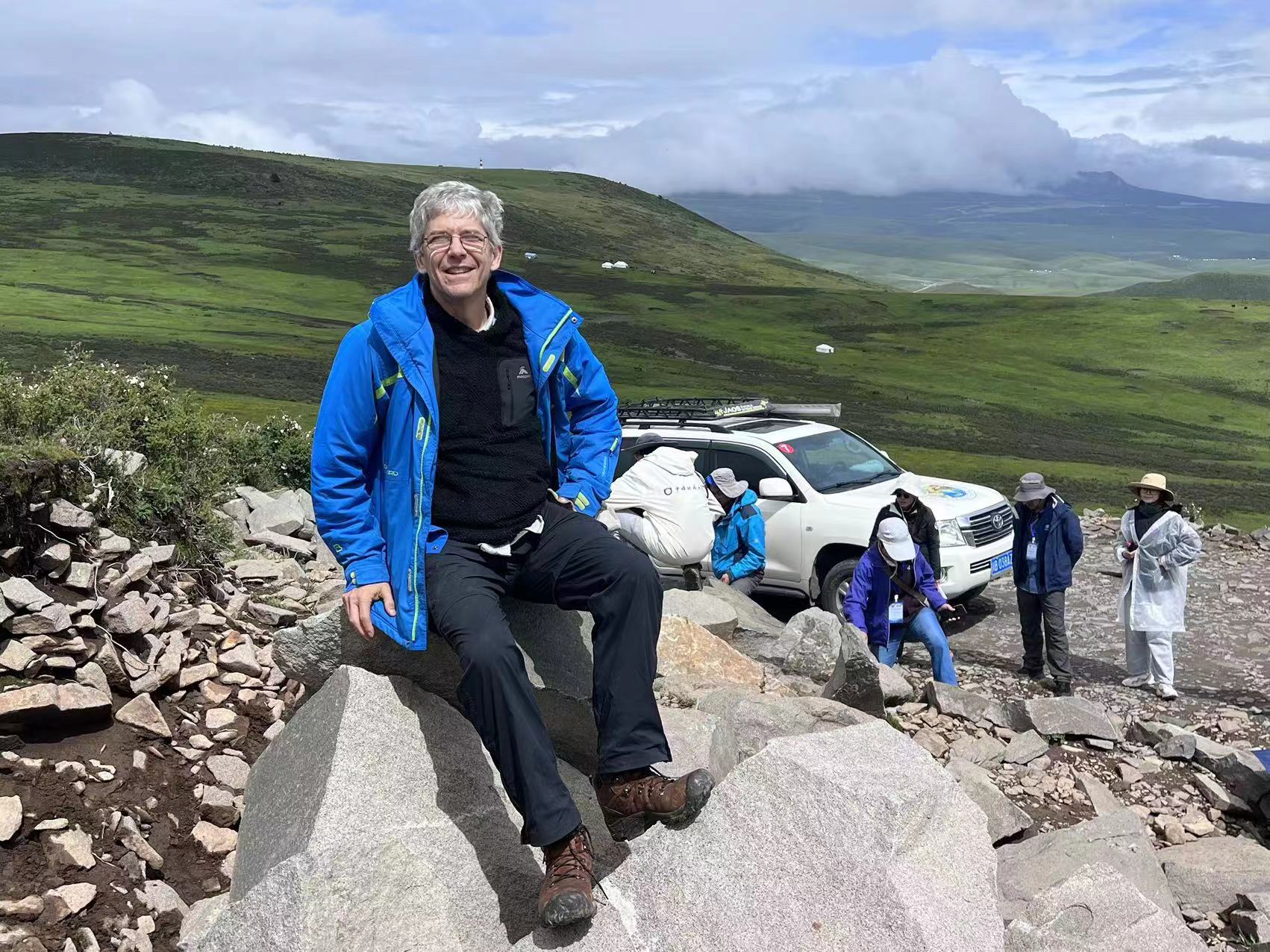 Roberto Ferrez Weinberg教授
个人简介:Roberto Ferrez Weinberg obtained his PhD from Uppsala University, Sweden, through the prestigious Hans Ramberg Tectonic Laboratory. He currently holds the position of Full Professor at the School of Earth, Atmosphere and Environment, Monash University, Australia. Active Research Projects include: 1) Ultra-precise dating in Earth, planetary and archaeological science ARC LIEF; 2) Cyclicity in magmatic arc systems – ARC DP20; 3) Project with China University of Geosciences – Beijing: Magmatic arcs on the Tibetan Plateau; 4) Project with Vale and Brazilian Geological Survey, Carajas Mineral Province, Brazil. He has authored and co-authored over 190 articles in prestigious ISI-listed journals including one publication in Nature, three publications in Nature Geosciences, two publications in Nature Communications, three in Earth-Science Reviews, 16 in Geology, and one in Annual Review of Earth and Planetary Sciences. Total Google citations exceeding 10,200. Impressive h-index of 59 and i-10 index of 150.
 朱弟成教授
朱弟成教授
个人简介:朱弟成,中国地质大学(北京)二级教授,博士生导师。国家杰出青年科学基金获得者(2012),教育部长江学者教授(2013),万人计划科技创新领军人才(2016),高等学校学科创新引智基地(111计划)负责人(2018),国家自然基金委创新群体负责人(2021)。曾获国土资源部科学技术奖一等奖(2012)、国家自然科学奖二等奖(2015)、教育部自然科学一等奖(2018)、李四光地质学奖科研奖(2023)和首都劳动奖章(2024)。
长期聚焦青藏高原“为何如此之大/之胖”重大科学挑战,发现并命名 Comei-Bunbury 大火成岩省,回答了印度大陆从澳大利亚大陆初始裂解的时间与机制问题;揭示了拉萨地体的起源、岩石圈成分结构和增生拼贴过程,支撑了拉萨地体的成矿理论创新和找矿勘探突破;提出堆晶-重熔两阶段过程实现了碰撞带大陆地壳的产生和保存,完善了大陆地壳形成演化的知识体系。
在Annual Review of Earth and Planetary Sciences、Nature Communications、Geology 和 Earth and Planetary Science Letters 等刊物发表论文 250 余篇,SCI 总引 18000 余次,H 指数 63。Lithos 主编,爱思唯尔 2014-2023 年高被引学者、科睿唯安 2020 年全球高被引学者。
报告简介:大陆地壳平均厚度为 35-40 km,具有安山质-英安质平均成分,比大洋地壳和地幔更具有浮力,是地球有别于太阳系其它行星的独特标志,也是地球宜居的前提。通常认为,大陆地壳主要形成于大洋俯冲带,保存于大陆碰撞带。因此,探索地球历史时期控制汇聚板块边缘岩浆产生和大陆地壳形成的驱动机制,对理解大陆地壳的产生和保存具有重要科学意义。板块重组是否影响以及如何影响汇聚板块边缘上盘的岩浆成分和大陆地壳的形成,是当前学术界探索的前沿科学问题。本报告以岩浆记录保存完整、年代学和地球化学数据丰富、控制岩浆产生的运动学过程清晰的青藏高原南部冈底斯岩基为例,探讨了板块重组如何控制了冈底斯岩基的形成。这为研究其它汇聚板块边缘大陆地壳的产生和保存机制提供了独一无二的参照对象。
欢迎广大师生踊跃参加!
2024年7月17日




 邮政编码:610059
 电子信箱:kxjsc@cdut.edu.cn
 地址:成都理工大学九教A座4、5楼
 CopyRight © 版权所有: 成都理工大学